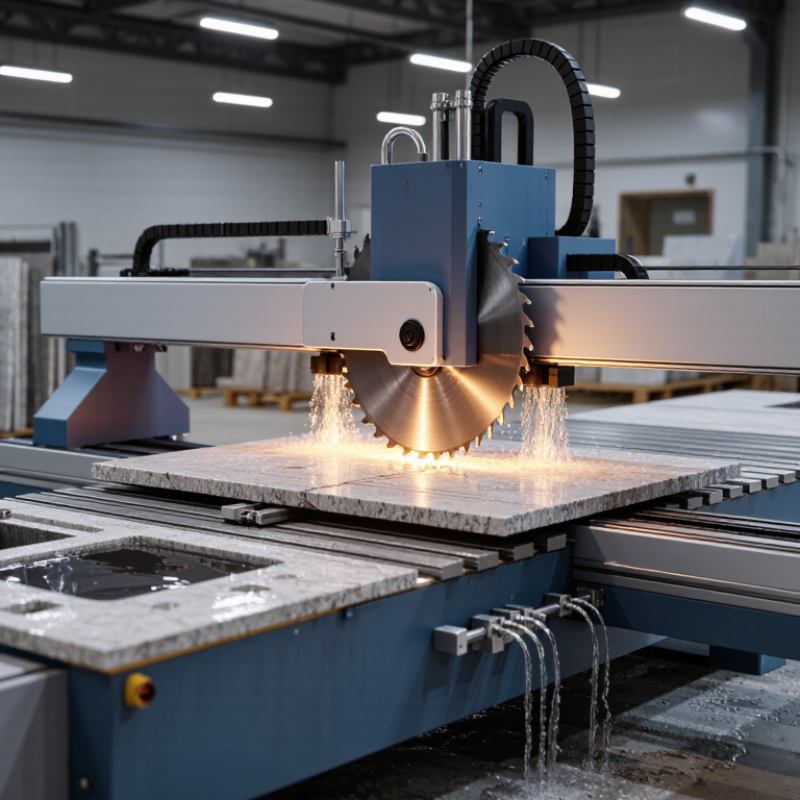
| Definition |
Machine configuration |
Bridge-mounted cutting head with an integrated worktable, guide system, and water-management area |
Combines material positioning and cutting functions in one workstation. |
Confirm that the machine layout accommodates the largest countertop sections handled in the workshop. |
| Selection |
Compatible materials |
Natural stone, engineered stone, porcelain slab, ceramic slab, and some compact surfaces |
Different materials require different blade specifications, feed rates, and cooling requirements. |
Check the machine manual and blade supplier guidance before cutting unfamiliar materials. |
| Selection |
Maximum cutting length |
Common workshop configurations: approximately 3,000–4,000 mm |
Determines whether full-length countertop pieces can be processed without repositioning. |
Choose a cutting length that exceeds the longest regular workpiece by a practical handling margin. |
| Selection |
Effective cutting thickness |
Typically about 20–100 mm, depending on spindle power, blade diameter, and material |
Countertop thicknesses vary, and laminated or reinforced sections may require additional capacity. |
Verify both the maximum blade penetration and the clearance below the workpiece. |
| Selection |
Blade diameter |
Often approximately 300–500 mm for bridge-saw applications |
Larger blades can provide greater cutting depth but may require more power and clearance. |
Use a blade diameter approved for the machine spindle, guard, and intended material. |
| Selection |
Electrical supply |
Common industrial supplies include three-phase systems at approximately 380–415 V |
Electrical compatibility affects installation cost, safety, and available motor performance. |
Have a qualified electrician verify voltage, phase configuration, grounding, and protection devices. |
| Selection |
Motor power |
Approximately 5.5–15 kW for many professional cutting applications |
Power influences cutting stability, production capacity, and the ability to process harder materials. |
Match power to material hardness, blade diameter, expected workload, and available electrical capacity. |
| Selection |
Positioning accuracy |
Typical mechanical or digital positioning accuracy: about ±0.5–1.0 mm |
Accurate positioning reduces waste and improves the fit of sink, cooktop, and seam cutouts. |
Confirm accuracy using a calibrated rule, test cut, or measuring equipment during commissioning. |
| Selection |
Worktable capacity |
Usually designed for slab sections weighing several hundred kilograms |
Insufficient load capacity can affect safety, table flatness, and cutting precision. |
Include the slab, supports, fixtures, and water load when calculating the total table load. |
| Selection |
Water-management system |
Recirculating tank, pump, spray lines, drainage channels, and sediment collection |
Water cools the blade, suppresses dust, and helps protect the cut surface. |
Provide adequate filtration or settling capacity and prevent slurry from entering ordinary drains. |
| Operation |
Pre-start inspection |
Check blade condition, guards, emergency stops, water flow, table cleanliness, and cable condition |
Many cutting incidents and quality problems originate from missed pre-start checks. |
Use a written inspection checklist before each shift or whenever the machine changes operators. |
| Operation |
Workpiece support |
Continuous, level support with no unstable overhangs or unsupported narrow sections |
Proper support reduces vibration, edge breakout, slab movement, and blade pinching. |
Use compatible support rails, sacrificial boards, and clamps where appropriate. |
| Operation |
Blade cooling |
Continuous water delivery directed at the cutting zone |
Insufficient water can overheat the blade, accelerate wear, and increase airborne dust. |
Confirm steady flow before entering the material and stop immediately if cooling is interrupted. |
| Operation |
Cutting feed rate |
Commonly about 0.5–3.0 m/min, depending on material, blade, thickness, and machine power |
Excessive feed can cause chipping, motor overload, or blade deflection. |
Start conservatively and adjust only within the limits specified for the blade and material. |
| Operation |
Plunge and pass strategy |
May require staged passes or reduced depth for thick, brittle, or laminated materials |
Progressive cutting reduces stress and helps maintain edge quality. |
Use the approved pass sequence rather than forcing a full-depth cut in one movement. |
| Operation |
Cutout corner treatment |
Internal corners should generally use a radius rather than a sharp square corner |
Rounded corners reduce stress concentration and the risk of cracking around sinks and cooktops. |
Follow the appliance template and maintain the minimum corner radius required by the material. |
| Operation |
Operator protection |
Eye protection, hearing protection, safety footwear, suitable gloves for handling slabs, and appropriate dust controls |
Wet cutting still involves noise, splash, sharp edges, heavy materials, and possible residual dust. |
Keep hands clear of the blade path and never bypass guards or interlocks. |
| Maintenance |
Daily cleaning |
Remove slurry, stone fragments, and standing water from the table, rails, guards, and floor |
Accumulated slurry can obstruct movement, corrode components, and affect positioning accuracy. |
Clean after each shift using approved methods and dispose of solids according to local requirements. |
| Maintenance |
Blade inspection |
Inspect before use for cracks, missing segments, uneven wear, warping, or excessive glazing |
A damaged or worn blade can reduce cut quality and create a serious safety hazard. |
Replace the blade when wear, damage, or performance falls outside the specified limit. |
| Maintenance |
Water pump and spray lines |
Inspect daily; clean filters and nozzles as needed |
Blocked lines reduce cooling and may produce uneven blade wear. |
Flush the system with clean water and remove sediment before it hardens. |
| Maintenance |
Guide rails and moving parts |
Check daily for slurry buildup, abnormal noise, looseness, or rough travel |
Contamination and misalignment can cause dimensional errors and premature wear. |
Clean, lubricate, and adjust only according to the machine maintenance instructions. |
| Maintenance |
Electrical and safety systems |
Test emergency stops, guards, limit switches, and visible electrical connections at scheduled intervals |
Safety devices must function reliably before production begins. |
Arrange periodic inspection by qualified maintenance personnel and isolate power before service. |
| Maintenance |
Calibration interval |
Verify after installation, relocation, collision, abnormal vibration, or noticeable dimensional drift |
Table or rail movement can reduce cut accuracy even when the blade appears serviceable. |
Record test results and recalibrate using a repeatable measurement procedure. |
| Maintenance |
Slurry handling |
Use settling, filtration, or suitable slurry-management equipment |
Stone slurry can clog drains, damage pumps, and create environmental compliance issues. |
Allow solids to settle, remove collected material regularly, and follow local disposal rules. |
| Quality Control |
Typical cut-quality checks |
Measure length, width, diagonal, cutout location, edge chipping, and surface damage |
Dimensional and visual checks identify problems before installation. |
Inspect the first completed piece of each setup and retain measurement records for repeat jobs. |
| Quality Control |
Common causes of chipping |
Incorrect blade, excessive feed, insufficient support, poor cooling, or worn segments |
Chipping is often a process issue rather than a material defect. |
Change one variable at a time and document the result during process adjustment. |
| Safety |
Lockout and isolation |
Disconnect and isolate electrical power before blade changes, cleaning inside guards, or repairs |
Unexpected movement or startup can cause severe injury. |
Use a formal lockout procedure and verify zero energy before beginning maintenance. |
| Safety |
Material handling |
Use suitable lifting equipment and trained personnel for large or heavy slabs |
Stone and slab materials can cause crush injuries even when the cutting machine is switched off. |
Plan the lifting route, keep bystanders clear, and never place hands under an unsupported slab. |
 TitanPro Cutting