TitanPro Cutting
Choosing the right machine for stone and metal fabrication is crucial. Among the popular options are bridge saws and CNC routers. Both machines have unique capabilities. Understanding what is the difference between bridge saw and CNC router can help you make an informed decision.
Bridge saws excel at cutting large slabs of material, making them ideal for stoneworkers. They provide precision in straight cuts and are powerful. On the other hand, CNC routers offer versatility. They can create intricate designs and patterns with ease. This machine is preferred for detailed work.
Your choice ultimately depends on the nature of your projects. If you mainly cut large materials, a bridge saw may be your best bet. However, if you require detailed engraving or shaping, consider a CNC router. Reflect on your specific needs before making a decision. Consider what type of work you do most often. Understanding these nuances will lead to better investment choices.
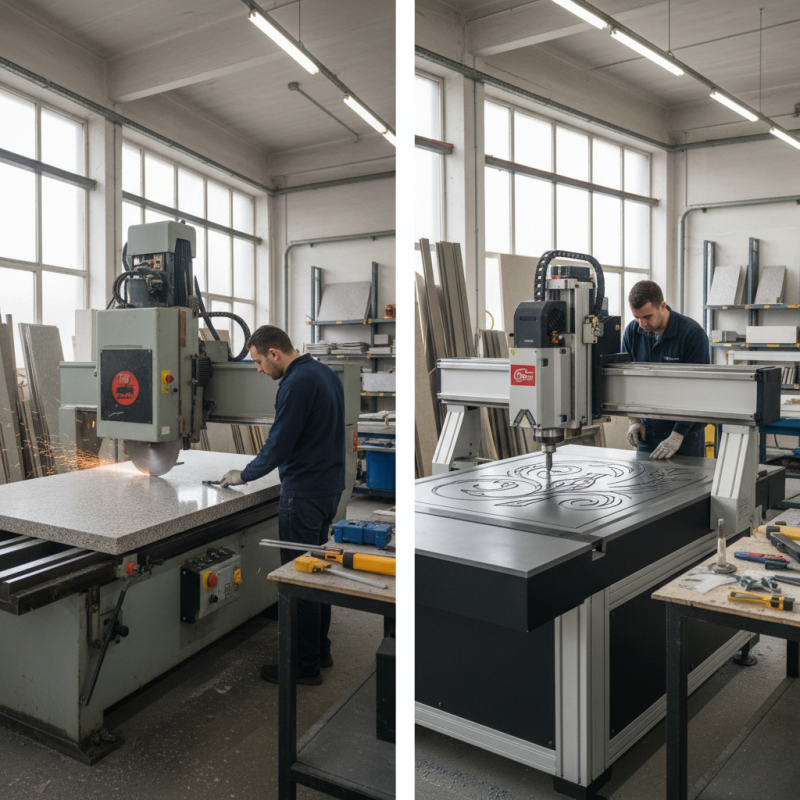
When considering bridge saws and CNC routers, it's vital to understand their basic functions. Bridge saws are designed primarily for cutting large slabs of material. They excel in precision cuts on stone, granite, and concrete. Reports suggest that the demand for bridge saws has increased by 25% in the last two years among stoneworking industries. This surge highlights their essential role in fabrication processes where straight cuts are common.
On the other hand, CNC routers offer advanced versatility. They can handle a variety of materials, including wood, plastics, and metals. A recent industry study revealed that over 60% of woodworking companies now utilize CNC routers for their ability to create intricate designs. This technology allows for detailed carvings and complex shapes, something a bridge saw cannot achieve. However, CNC routers may require more training and precision than some users expect. This complexity can lead to a learning curve that may hinder immediate productivity.
Both tools serve distinct purposes in manufacturing and fabrication. While bridge saws focus on efficiency in cutting large slabs, CNC routers provide flexibility for detailed work. Each machine comes with its limitations and advantages. Evaluating your specific requirements is crucial before making a decision.
When it comes to precision cutting, both bridge saws and CNC routers have their unique strengths. A bridge saw is ideal for large stone slabs, offering straight cuts with minimal chipping. Its simplicity allows for reliable operation, especially for thick materials. In contrast, a CNC router excels at intricate designs and complex shapes. This machine can carve and engrave with remarkable accuracy, making it a preferred choice for detailed work.
The choice between the two largely depends on your specific needs. If you primarily work with heavy materials and require quick, straightforward cuts, a bridge saw might be the answer. However, if your projects often involve elaborate patterns or customized designs, investing in a CNC router could be more beneficial. It’s essential to consider the types of materials you plan to use and the complexity of your designs.
It's worth noting that each machine requires thorough training and skill. Using a bridge saw incorrectly can lead to wasted materials. Similarly, a CNC router demands an understanding of software and programming. Mistakes can occur, leading to frustrating setbacks in production. Proper training and experience are key to unlocking the full potential of these machines.
When deciding between a bridge saw and a CNC router, cost-effectiveness plays a crucial role. The average upfront cost of a bridge saw can range from $20,000 to $50,000, while CNC routers typically start around $30,000. However, the long-term return on investment (ROI) can significantly differ. Studies show that CNC routers often lead to lower labor costs due to automation, which can enhance production efficiency by up to 30%.
On the other hand, a bridge saw excels in material waste reduction. Reports indicate that it can minimize waste by 15% when cutting large stone slabs. This efficiency lowers material costs in the long run. However, maintenance expenses must be considered. CNC routers can require more frequent maintenance, adding hidden costs. Some services estimate annual maintenance for a CNC router could reach up to 10% of the initial purchase price.
Making a choice necessitates a detailed analysis of both initial costs and potential savings. Users should weigh the benefits of precision and speed offered by CNC routers against the lower operational costs associated with bridge saws. Understanding these factors can lead to a more informed decision that aligns with business goals.
When selecting between a bridge saw and a CNC router, understanding material suitability is crucial.
Bridge saws excel when cutting hard materials such as granite and quartz. These powerful machines provide precision and speed, making them ideal for stone fabricators.
For instance, industry studies reveal that a bridge saw can reduce cutting time by up to 30% compared to manual methods.
On the other hand,
CNC routers are versatile tools suited for softer materials like wood, plastics, and composites. They offer intricate design capabilities with high precision.
Recent reports indicate that CNC routers can achieve cutting tolerances of 0.01 inches, which is vital for detailed projects.
However, their performance on harder materials may not match that of bridge saws, sometimes resulting in slower processing times and increased wear on bits.
It's important to assess not only the materials but also the finishing quality required. A bridge saw may produce smoother edges on stone, while a CNC router can create complex patterns.
Both machines have their strengths and weaknesses, and choosing the right one depends on specific project demands.
A thoughtful approach will lead to better final products while utilizing resources efficiently.
When selecting between a bridge saw and a CNC router, production volume is a critical factor. The bridge saw is often favored for its speed in cutting large slabs of stone or tile. It excels in high-volume environments where precision and efficiency are paramount. If your projects frequently involve sizable materials, a bridge saw may meet your needs effectively. However, it has limitations in versatility, primarily focusing on straight cuts without the adaptability of advanced shapes.
In contrast, a CNC router allows for intricate designs and more specialized cuts. This machine is ideal for detailed work. If your production involves various materials or complex patterns, a CNC router could enhance your capabilities. Yet, it may not match the speed of a bridge saw when handling straightforward tasks. Assessing your output requirements means considering both the types of materials used and the designs produced.
Understanding your production needs requires reflection. Do you need speed or versatility? Are your projects volume-heavy or design-centric? Evaluating these aspects helps clarify the best choice. Both machines have their strengths and weaknesses, making it essential to align their capabilities with your specific production goals.
| Machine Type | Production Volume (Units/Hour) | Material Compatibility | Setup Time (Minutes) | Cutting Precision (mm) |
|---|---|---|---|---|
| Bridge Saw | 20-50 | Stone, Tile | 15 | 0.5 |
| CNC Router | 10-30 | Wood, Plastics, Composites | 10 | 0.2 |
: Bridge saws are mainly for cutting large slabs of materials like stone and concrete.
CNC routers offer versatility, handling wood, plastics, and metals, while bridge saws focus on straight cuts.
CNC routers excel at intricate designs and complex shapes, allowing for detailed carvings and engravings.
Yes, using a bridge saw requires training to prevent mistakes and material wastage.
Bridge saws typically cost between $20,000 and $50,000, depending on features.
While initial costs start around $30,000, CNC routers may incur higher maintenance expenses.
Bridge saws can reduce material waste by up to 15%, which helps lower costs over time.
Yes, CNC routers may have a steep learning curve due to required software understanding.
Yes, both machines can complement each other based on material needs and design complexity.
Consider the type of materials, desired complexity of designs, and training availability.
When considering what is the difference between bridge saw and CNC router, it's essential to understand their basic functions and applications. Bridge saws are primarily used for cutting large slabs of stone or granite with high precision, making them ideal for mass production of countertops and tiles. In contrast, CNC routers excel in machining wood, plastics, and softer materials, offering intricate designs and customizable shapes, suitable for furniture and decorative purposes.
A comparative analysis of precision reveals that both machines deliver high accuracy, but their effectiveness depends on the material being processed. Cost-effectiveness plays a crucial role in decision-making; while bridge saws often have a lower initial investment, CNC routers can provide a better long-term ROI due to their versatility. Additionally, assessing the production volume needs is crucial, as bridge saws are designed for high-output operations, while CNC routers cater to varied production scales, allowing businesses to select the right tool for their specific needs.
