TitanPro Cutting
Choosing a bridge saw shapes daily output, cut quality, and workshop layout. For buyers comparing China-made equipment, the key question is what are the advantages of monoblock bridge saws? Their one-piece frame can reduce on-site assembly and simplify installation. It may also help keep the blade path stable during straight cuts. These benefits depend on engineering, transport, installation, and maintenance—not the machine’s origin alone.
The U.S. Geological Survey’s Mineral Commodity Summaries 2024 tracks dimension-stone production and trade, providing useful context for a market that depends on reliable slab processing. However, it does not compare saw designs or certify individual machines. Buyers should therefore check measurable specifications: cutting accuracy, blade diameter, motor power, table size, water use, and service support. Ask for test cuts on the stone types you actually process. A polished granite edge can reveal problems that a product brochure cannot.
A verifiable, published quotation from a named expert on monoblock bridge saws was not provided, so attributing one here would risk misleading readers. That caution matters. A rigid frame may reduce alignment work, but it cannot compensate for poor calibration, worn components, or weak after-sales support. Compare factory records, warranty terms, spare-part availability, and independent customer references before deciding. The details count.
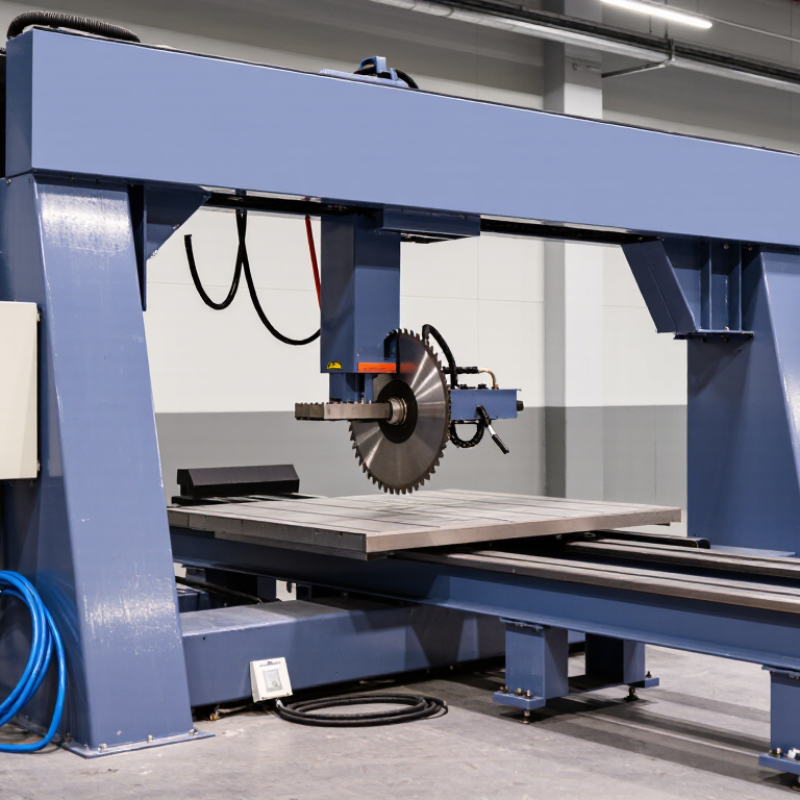
A monoblock bridge saw is a stone-cutting machine built around a compact, integrated frame. Its bridge carries the cutting head above a worktable, where a stone slab is positioned and secured. Because major structural components are assembled as one unit, the machine can often be installed with fewer frame-alignment steps than a sectional design. Actual setup needs depend on the model and site conditions.
During a cut, the blade spins while the cutting head moves along the bridge. The operator sets the cutting path and depth through the control system, then feeds the slab into position. Water flows near the blade to cool it and help control stone dust. The cut is precise when the slab is stable, the blade is suitable, and the machine is correctly calibrated. Small setup errors matter.
A monoblock frame can help maintain alignment and reduce the space needed for installation. That can be useful in workshops with limited floor area. Yet compact does not mean maintenance-free. Rails, blade condition, water flow, and electrical connections still need regular checks. Even a sound machine can produce uneven edges if the slab shifts or the blade wears. A test cut on scrap stone is a sensible check before processing valuable material.
China-made monoblock bridge saws integrate the bridge, table supports, and base into one frame. This design can reduce on-site assembly and alignment work. Setup becomes simpler. However, a rigid frame still depends on a level floor and careful installation. Small alignment errors can affect cut quality.
Common design features include CNC-controlled axes, linear guides, adjustable cutting parameters, and water-fed blade cooling. Servo drives support controlled movement across large stone slabs. Enclosed water channels help manage slurry near the cutting area. Energy use deserves attention. The International Energy Agency’s 2011 report, Energy-Efficiency Policy Opportunities for Electric Motor-Driven Systems, estimates that motor-driven systems account for about 46% of global electricity consumption. This broad figure is not specific to saws, but it makes spindle efficiency and idle power worth checking. Ask suppliers for measured cutting tolerances, frame-leveling requirements, and service access details. The brochure may look precise; real shop conditions are less tidy.
A monoblock bridge saw uses a rigid, integrated frame to help keep the blade path steady. This matters when cutting thick slabs or repeating countertop profiles. A stable bridge can reduce vibration, helping operators achieve cleaner edges and more consistent dimensions. ISO 230-1 describes standardized methods for checking machine-tool geometric accuracy, including straightness and squareness. Ask suppliers for measured test results, not just claims. Precision varies with setup, blade condition, and operator skill.
Stability also supports cutting efficiency. A firm structure helps the blade track through dense stone without unnecessary wandering, while programmable movement can reduce repeated manual positioning. OSHA sets an eight-hour permissible exposure limit of 50 micrograms per cubic meter for respirable crystalline silica. Wet cutting and well-managed water delivery can help control dust while keeping the blade cool. They do not replace proper exposure controls. Still, no machine is perfect; poor leveling or a worn blade can undermine its advantages.
Tips: Check the machine’s leveling, blade alignment, and water flow before production. Run a short test cut on a scrap piece, then measure the edge and repeatability. Small checks matter.
Monoblock bridge saws are suited to processing large, flat stone slabs into accurately sized pieces. Their rigid frame and guided cutting action can help maintain straight edges across countertop-length cuts. That matters. A stable slab support and suitable blade also reduce chipping, though results depend on setup and operator skill.
Common materials include granite, marble, quartzite, and engineered stone. Some machines can also cut porcelain slabs, but thin or brittle material may need extra support and careful handling. Match the blade and feed rate to the material, and follow the machine’s operating guidance. Wet cutting helps control heat and dust. Test cuts help.
These saws work well for kitchen countertops, bathroom vanities, floor panels, and selected wall-cladding pieces. They are especially useful when a project involves repeated straight cuts or sizable slabs. For sink openings, narrow strips, or angled edges, plan the cut sequence before production. A bridge saw is not a substitute for checking slab flaws, measuring twice, or finishing exposed edges. Even a precise machine can produce waste if the stone has hidden cracks or the layout ignores its natural veining.
Typical material suitability for slab cutting and fabrication projects
Monoblock bridge saws are commonly used to cut granite, marble, engineered quartz, porcelain, and ceramic for projects such as countertops, vanity tops, wall panels, flooring, and stairs. Ratings are qualitative guidance, not measured performance; results depend on the saw configuration, blade, material, and operating method.
Choosing a monoblock bridge saw starts with the work it must handle. Measure your largest slabs and confirm the cutting length, width, and blade clearance match them. Check the saw’s maximum cutting depth against the materials you use, including thicker stone. A machine that looks substantial may still fall short on usable travel. That detail matters.
Consider the workshop layout, too. A monoblock frame arrives as one integrated structure, so check doorways, floor capacity, and installation space before ordering. Ask about power requirements, water delivery, and slurry management. These affect daily operation as much as cutting speed. Look for clear controls, accessible maintenance points, and guarding that helps operators work safely. Service support and spare-part availability are worth confirming in writing. A fast demonstration is useful, but it may not reflect a full shift with varied slabs.
Tips: Bring a sample piece and test a representative cut. Watch for vibration, edge chipping, and how easily the head returns to position. Ask how often alignment checks are needed. Keep enough room around the machine for loading and cleaning. One overlooked issue: cleanup takes time, and wet slurry can make a tidy plan less tidy. Compare the complete setup, not just the saw’s headline specifications.
| Factor | Potential Advantage | What to Check | Practical Selection Guidance |
|---|---|---|---|
| Integrated frame | A one-piece or highly integrated structure can reduce on-site assembly and help maintain alignment when properly designed and manufactured. | Frame construction, transport dimensions, leveling points, and installation requirements. | Confirm that the machine can be moved into the workshop and installed on the available floor and foundation. |
| Setup and commissioning | Compared with machines requiring extensive frame assembly, an integrated design may simplify setup. | What is included in installation, calibration, operator training, and commissioning support. | Ask for a written list of site requirements, setup tasks, and services included with the purchase. |
| Cutting capacity | Bridge-saw configurations can support straight cuts and, where equipped, angled or shaped cuts across different workpiece sizes. | Maximum cutting length, width, thickness, blade diameter, and any limits for miter or profiling operations. | Compare the stated capacity with the largest slabs and finished parts used in your actual workflow. |
| Structure and cutting stability | A rigid frame and accurately aligned bridge can help produce consistent cuts and reduce vibration during operation. | Frame stiffness, guide and bearing design, alignment procedure, and test-cut results. | Request a demonstration or documented test cut using a material and thickness similar to your production work. |
| Drive and blade system | A suitable motor, blade, and feed system can support efficient cutting for the intended material and production rate. | Motor power, blade compatibility, rotation speed, feed control, electrical supply, and overload protection. | Match the specification to the material; cutting performance also depends on blade type, condition, and operating settings. |
| Controls and positioning | Manual, semi-automatic, or CNC controls can help repeat jobs and reduce positioning effort when configured for the task. | Axis functions, programming interface, positioning accuracy, file compatibility, and operator training needs. | Choose control functions based on job complexity and volume rather than assuming that more automation is always necessary. |
| Water management | Wet cutting can cool the blade and help control airborne dust generated during stone cutting. | Water flow requirements, drainage, splash control, filtration or recycling options, and local wastewater rules. | Plan water supply and slurry handling before installation; follow applicable workplace and environmental requirements. |
| Worktable and slab handling | A suitable table and support arrangement can make loading, positioning, and cutting workpieces more practical. | Table dimensions, load rating, support surfaces, access for lifting equipment, and available turning or tilting functions. | Check the full handling process for your slabs, including loading clearance and safe movement around the saw. |
| Safety features | Appropriate guards, emergency stops, electrical protection, and operating procedures can help reduce workplace risks. | Guarding, interlocks, emergency-stop access, electrical documentation, and conformity with regulations applicable at the installation site. | Have a qualified person review the machine and installation against local safety requirements before operation. |
| Maintenance and support | Accessible components and clear maintenance instructions can make routine inspection and servicing easier. | Maintenance schedule, spare-parts availability, warranty terms, technical documentation, and response arrangements. | Compare total ownership requirements, not just the purchase price; obtain service and parts terms in writing. |
It has an integrated frame, a bridge-mounted cutting head, and a worktable for securing stone slabs.
The blade spins as the cutting head travels along the bridge. Water cools the blade and helps control dust.
A rigid frame can support steady cuts and repeatable dimensions. Results still depend on setup, blade condition, and operator skill.
Common materials include granite, marble, quartzite, and engineered stone. Porcelain may need extra support and careful handling.
It works well for countertop-length cuts, floor panels, vanities, and selected wall pieces. Small details may need extra planning.
Level the machine, check blade alignment, and confirm water flow. Make a test cut on scrap stone, then measure the edge.
No. Rails, the blade, water delivery, and electrical connections still need regular checks. Compact does not mean maintenance-free.
A shifting slab, worn blade, poor leveling, or hidden cracks can affect the cut. Measure twice. Natural veining deserves attention too.
A monoblock bridge saw is a stone-cutting machine built around a single, integrated frame that supports the bridge, cutting head, and worktable. This compact design can simplify installation and help maintain alignment during operation. China-made models may include features such as rigid structures, programmable controls, adjustable cutting settings, and water systems for cooling the blade and managing dust. Together, these elements help operators achieve consistent cuts while supporting efficient, repeatable production.
When considering what are the advantages of monoblock bridge saws, key benefits include precision, stability, and productive use of workshop space. They can suit materials such as granite, marble, engineered stone, and other slabs, as well as projects involving countertops, tiles, and architectural components. Before choosing a machine, buyers should assess cutting capacity, accuracy, control options, power requirements, maintenance needs, available workspace, and the types and volume of work they expect to handle.
